
Tax-free savings accounts in South Africa: the 2026 rules, and how to use one well
The short answer
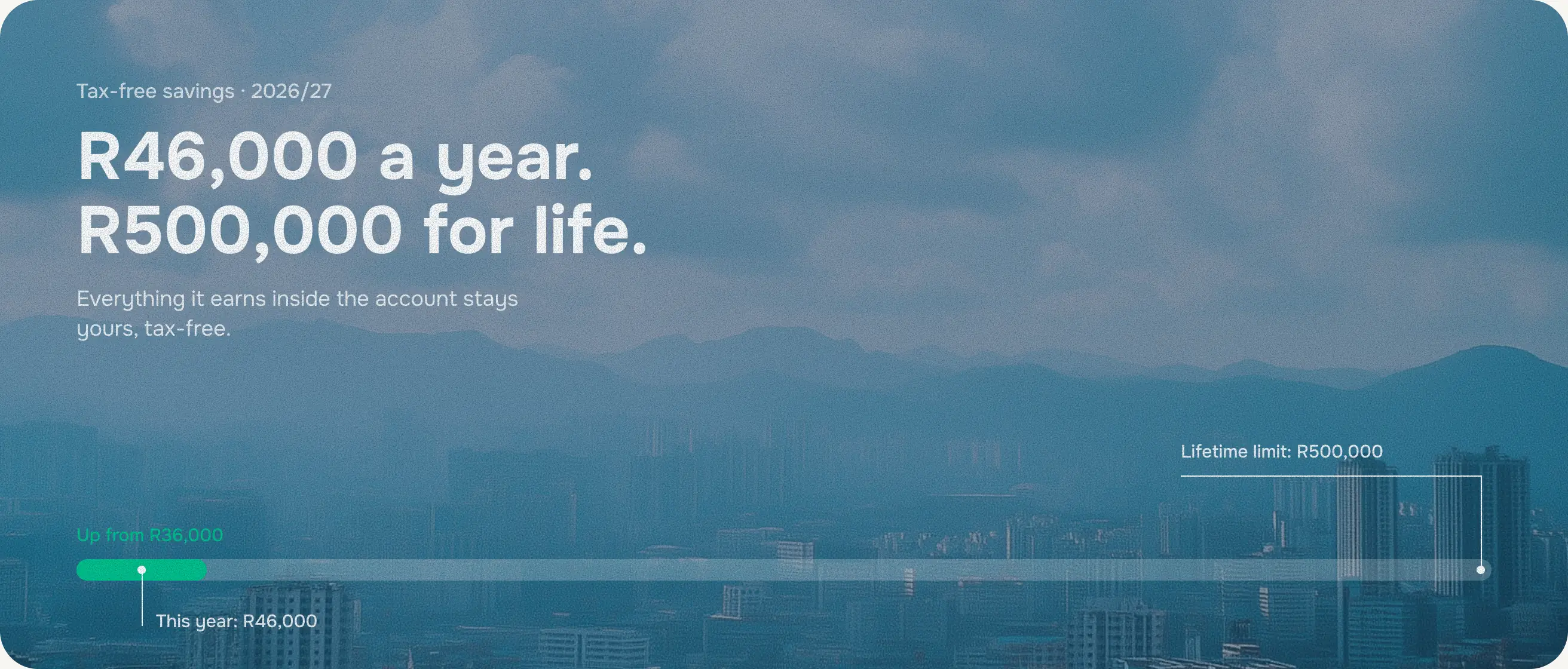
A tax-free savings account (TFSA) lets you save or invest up to R46,000 a year, and R500,000 over your lifetime, without paying tax on the interest, dividends or growth. The annual limit went up from R36,000 on 1 March 2026. Go over either limit and SARS charges 40% on the excess.
What is a tax-free savings account?
A TFSA isn’t one specific product. It’s a wrapper that banks, investment platforms and asset managers put around different kinds of savings and investments. Inside the wrapper, what your money earns isn’t taxed: no income tax on interest, no dividends tax and no capital gains tax.
That’s why the same name covers very different things. One provider’s TFSA might be a cash account paying interest. Another’s might hold unit trusts or ETFs that move with the markets. The tax benefit is the same. What happens to your money inside the wrapper isn’t.
How much can you put in?
The limits for the 2026/27 tax year:
| Limit | What it means | Amount |
|---|---|---|
| Per tax year | Between 1 March 2026 and 28 February 2027 | R46,000 |
| Per month | If you spread it evenly | About R3,833 |
| Lifetime | Across all your TFSAs, for life | R500,000 |
| Penalty | On anything above either limit | 40% of the excess |
Checked November 2026. The first increase to the annual limit since 2021.
The limits are per person, not per account. Two TFSAs with two providers still share one R46,000 a year.
They count what you put in, not what it grows to. If growth takes your balance past R500,000, that’s fine.
A formal transfer between providers doesn’t use up your limit. Withdrawing the money yourself and depositing it somewhere else counts as a new contribution.
What happens if you go over?
SARS adds 40% of the excess to your tax bill. Say you put R50,000 into TFSAs this tax year. That’s R4,000 over the limit, so you’d pay R1,600 in extra tax, which can wipe out years of tax-free growth on that money.
Worth knowing
If you have more than one TFSA, or someone else contributes for you, keep your own running total. Each provider only sees its own account.
Can you take money out?
Yes, but a withdrawal doesn’t give you that room back. If you put in R30,000, take out R10,000 and then put R10,000 back, SARS counts R40,000 in contributions for the year.
That makes a TFSA a poor home for money you might need soon. It works best for money you can leave alone for years, where the tax-free growth has time to add up.
Your options
There’s no single right choice. Three honest starting points:
Cash TFSA Steady, and easy to plan around. Your balance doesn’t drop and you earn interest. Better if you might need the money within a few years.
Investment TFSA More room to grow. Values move with the markets, but over long periods there’s more growth for the tax break to protect.
Something else first Same goal, different order. If you don’t have a buffer yet, or you’re paying high interest on debt, those can come first.
Whichever you choose, compare total fees, not only the headline rate. You have until 28 February 2027 to use this year’s R46,000, and room you don’t use doesn’t carry over. A December bonus is a common way to top up, see What to do with your bonus or 13th cheque.
Where Vault22 fits, and where it doesn’t
Vault22 doesn’t open a TFSA for you right now, but TFSA’s will be an option for customers directly in the app early 2027. That’s done with a bank or investment provider. Where we help is the part before that decision: knowing what you can actually afford to put away each month without leaving yourself short.
You can start free, with budgets, goals, AI guidance and weekly account updates included. Paid plans from ZAR75 a month add daily updates, lower investment fees and accounts from more than one region.
See what you can put away each month
Start free, link your accounts and set a goal.
Questions people ask
R46,000 for the tax year from 1 March 2026 to 28 February 2027, and R500,000 over your lifetime.
Yes, but they all share your one annual limit and one lifetime limit.
Yes. Each child has their own limits. What you put in for them now uses up their lifetime limit, so it’s worth thinking about before you start.
No. But withdrawn money doesn’t give you back any of your limit.
SARS adds 40% of the excess to your tax bill.
This guide is general information to help you understand your options. It isn’t financial advice and doesn’t consider your personal circumstances.


See where you stand, in one place.
Start free, link your accounts and see what’s left for the things that matter.